Events
Projects
3MIN
20/7/2026
A project aimed at promoting accessibility and supporting the mental health of medical and social workers in frontline communities in the Kharkiv and Mykolaiv regions has come to a close.
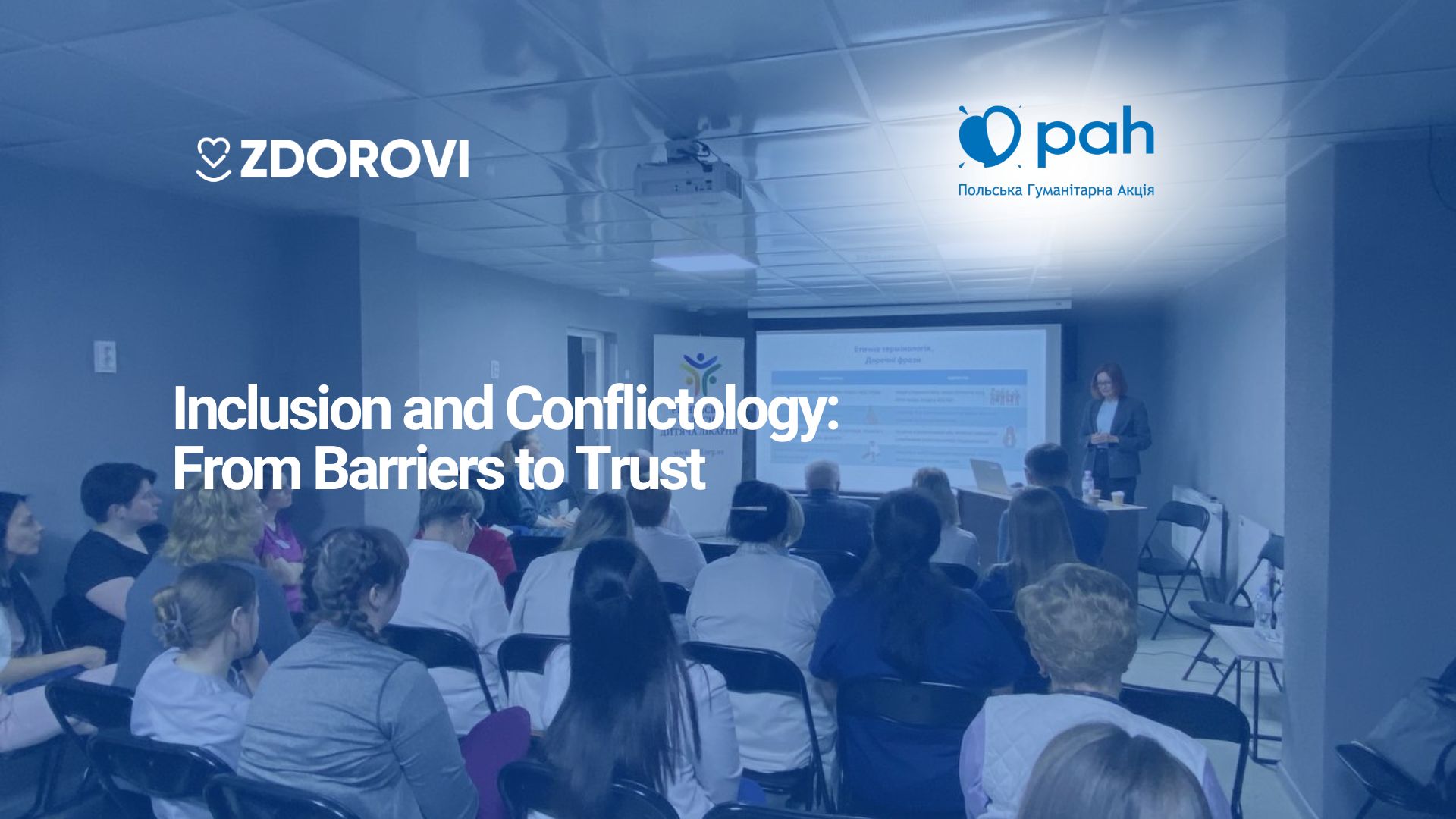
Its findings revealed an important pattern: the most significant changes occur not when new ramps are installed or facilities are renovated, but when people's attitudes toward those in need of assistance begin to shift.
Over the course of seven months, ZDOROVI, with the support of the Polish Humanitarian Action (PAH), worked with healthcare and social service institutions in communities that provide daily assistance to veterans, people with disabilities, internally displaced persons, older adults, and other residents in need of support. Initially, the project was planned to involve 12 institutions; however, as the work progressed, the number grew to 15.
In total, project specialists conducted 120 hours of expert consultations, during which facility managers and their teams received practical recommendations on implementing inclusive approaches. For many institutions, this provided their first comprehensive understanding of accessibility — not as a standalone project, but as an integral part of the facility's strategic development.
It is important to note that the changes were not limited to infrastructure alone. As part of the project, a series of training sessions was conducted on accessibility, inclusive communication, and conflictology. A total of 355 employees from medical and social service institutions participated in the training. Test results showed that 9 out of 10 participants improved their knowledge, with an average increase in knowledge level of nearly 46%.
However, the most interesting results were not reflected in the training statistics.
At the start of the project, all participating facilities underwent an accessibility audit. Experts assessed not only architectural solutions but also communication practices, internal processes, and the institutions' readiness to work with diverse groups of people. Within just a few months, employees themselves reported that the level of accessibility and inclusivity at their facilities had increased by an average of 20.7%. Visitors also noticed the changes and rated the improvements at 10.5%.
Indicators of physical accessibility increased by 3.6%. At first glance, this figure may seem insignificant. However, it highlights one of the main challenges facing frontline communities. Many institutions operate in old or temporary facilities, lack the funds for major renovations, and are forced to prioritize maintaining essential services amid the war. As a result, architectural barriers often cannot be removed quickly.
Despite this, changes are already taking place. Staff have learned to better understand the needs of people with disabilities, older adults, veterans, and internally displaced persons, as well as to communicate more effectively with visitors. In fact, the project has demonstrated that accessibility begins not with renovating a building, but with changing approaches within an institution.
Another important finding concerns the mental health of staff members.
As part of the project, 76 group and 170 individual psychological sessions were conducted, involving 382 professionals. More than 89% of participants reported improved knowledge and skills related to the prevention and management of burnout.
During individual and group psychological sessions, medical professionals and social workers most often spoke about anxiety about the future, loss, emotional exhaustion, sleep disturbances, difficult family situations, and conflicts in communication with patients and their families. For many, this was the first opportunity to openly discuss the consequences of working in the context of a prolonged war.
The results were significant. The level of professional burnout among participants decreased by 39.6%. Participants also reported improved teamwork, greater psychological resilience, and increased confidence in handling complex cases.
The results of the focus groups with healthcare workers were particularly telling. Nearly 90% of participants reported that, after taking part in the psychological sessions, they had a better understanding of how to recognize the signs of professional burnout. The greatest increase was observed in confidence in their ability to identify burnout in themselves or their colleagues — this figure more than doubled.
In total, 737 employees participated in the training and psychological support activities — more than twice the number anticipated at the project's launch.
An important impact of the project is its long-term component. All participating institutions received professional accessibility audits and individualized action plans for implementing changes. For many communities, this became the first systematic roadmap for developing a barrier-free environment.
In addition, to scale up the experience, an online course titled “Inclusion and Conflictology: From Barriers to Trust” was created. Since the project's completion, professionals from various regions of Ukraine have continued to take the course. Within a month of its launch, 1,478 people registered for the training, and 1,165 successfully completed the course and received certificates.
Although hundreds of employees from medical and social institutions participated directly in the project, its impact is much broader. According to the team's estimates, the knowledge and skills acquired through the project can improve the quality of services for more than 22,000 residents of communities in the Kharkiv and Mykolaiv regions.
The project's main conclusion is that even in frontline regions, where resources are limited and the challenges of war remain a daily reality, change is possible. And it does not begin with large budgets or major renovations, but with the people who interact every day with patients, visitors, and those in need of support.
“When we started this project, the focus was on accessibility and support for medical professionals. But its results turned out to be much broader. We saw that change begins where people feel supported, expand their knowledge, and are willing to rethink their work. That is why the most important outcome has been the professional development of hundreds of medical and social workers who are now more confident in helping others. We thank the Polish Humanitarian Action for a fruitful partnership,” said Nataliia Tulinova, Foundress and CEO of ZDOROVI.
© 2026 zdorovi. all rights reserved.
контакти
strategy@zdorovi.agency
+380508000924 - контакт-центр фонду
Адреса: 01014, м. Київ, вул. Звіринецька, 63, офіс 1
website by WHYER.AGENCY