Events
3MIN
10/9/2026
On September 9, ZDOROVI held a practical masterclass, “AI for Healthcare Executives: Managing Complexity, Automation, and Preparing Management Decisions,” which brought together more than 50 healthcare facility leaders.

During the online training, healthcare executives and managers explored how to use artificial intelligence in their daily work — from processing large volumes of information and preparing documents to conducting analysis and preparing management decisions.
The masterclass was led by Anton Savochka, PhD in History, certified ToP facilitator, business trainer, and ICF-standard coach. He has more than 12 years of experience implementing educational and strategic projects in 20 countries and specializes in the practical application of artificial intelligence in management.
“We want healthcare facility leaders to see AI not as a trendy technological tool, but as a practical assistant in their daily work. It is about freeing up time from routine tasks, working with large volumes of information more quickly, and preparing for management decisions more effectively. At the same time, it is important to understand the limits of this technology — especially when it comes to data and managerial responsibility,” says Kateryna Malysheva, Head of Education Department at ZDOROVI.
AI can already be useful far beyond simply generating text. During the masterclass, participants worked with the capabilities of ChatGPT, Claude, and Gemini and explored how to integrate these tools into real-world management processes.
In particular, the session covered how AI can be used to:
- process large volumes of documents, reports, regulatory materials, and statistics;
- quickly structure information and identify trends and deviations;
- turn large datasets into a concise analytical brief for a manager;
- prepare drafts of SOPs, internal documents, presentations, and correspondence;
- analyze donor requirements and prepare drafts of grant applications;
- work with requests, schedules, reporting, and other operational tasks;
- develop several possible courses of action in complex management situations.
Participants also explored how to work with large volumes of information in a project workspace: how to upload the necessary documents, compare them with one another, and use AI to find relevant information and prepare conclusions.
One of the key topics of the masterclass was the boundary between automation and managerial responsibility.
AI can structure information, highlight potential risks, suggest courses of action, help test assumptions, or model “what if” scenarios. But the final decision remains with the manager.
This is particularly important in healthcare, where management decisions can affect team performance, the use of resources, and the quality of medical care.
“I would highlight three simple principles for managers working with artificial intelligence. First, it is worth using not just one, but at least two different models. This helps provide a more objective picture, compare responses, and develop your own critical thinking. Second, it is important to talk with colleagues about using AI in work processes. The team should see that the manager understands the tool themselves and is ready to use it responsibly. And third, at least once every six months, it is worth asking your AI assistant to tell you about key updates and new capabilities. This helps you not simply try AI once, but use it effectively and consistently in your work.
AI does not take away a manager’s responsibility for decisions — it helps them prepare better to make those decisions. Its value for a manager is not simply in writing text faster, but in structuring large amounts of information, identifying trends, testing possible scenarios, and asking the right questions. But the final decision, especially in healthcare, remains with a human,” emphasizes Anton Savochka, the masterclass trainer.
During the practical session, participants worked through a real management case: from reviewing and analyzing the initial information to preparing an analytical brief and several decision options for a hospital board.
Another important part of the training focused on the safe use of AI.
Healthcare facilities work with large volumes of information, including personal and medical data, internal documentation, commercial information, and other sensitive data. Therefore, before using general-purpose AI services, it is important to understand which data can be shared, which requires anonymization, and which should not be entered into external systems at all.
Participants also discussed the need for internal AI-use policies within organizations and the role of such policies in information and cybersecurity.
Participants highlighted this aspect as one of the most practical parts of the training. After all, effective use of AI is not only about writing the right prompt, but also about understanding the risks, responsibilities, and limits of the technology.
The masterclass used practical cases based on the following approach: example → tool → prompt → ready-to-use result.
Participants received practical approaches and templates that can be adapted to their own work — from preparing analytical briefs and SOPs to working with grant applications, correspondence, and management cases.
The aim of this approach was not only to introduce healthcare leaders to new technologies, but also to demonstrate which parts of their daily work can already be delegated to AI, and where it is critical to keep human control, verification, and final decision-making.
Participants with an education and certificate in “Healthcare Organization and Management” could receive 4 Continuing Professional Development (CPD) points.
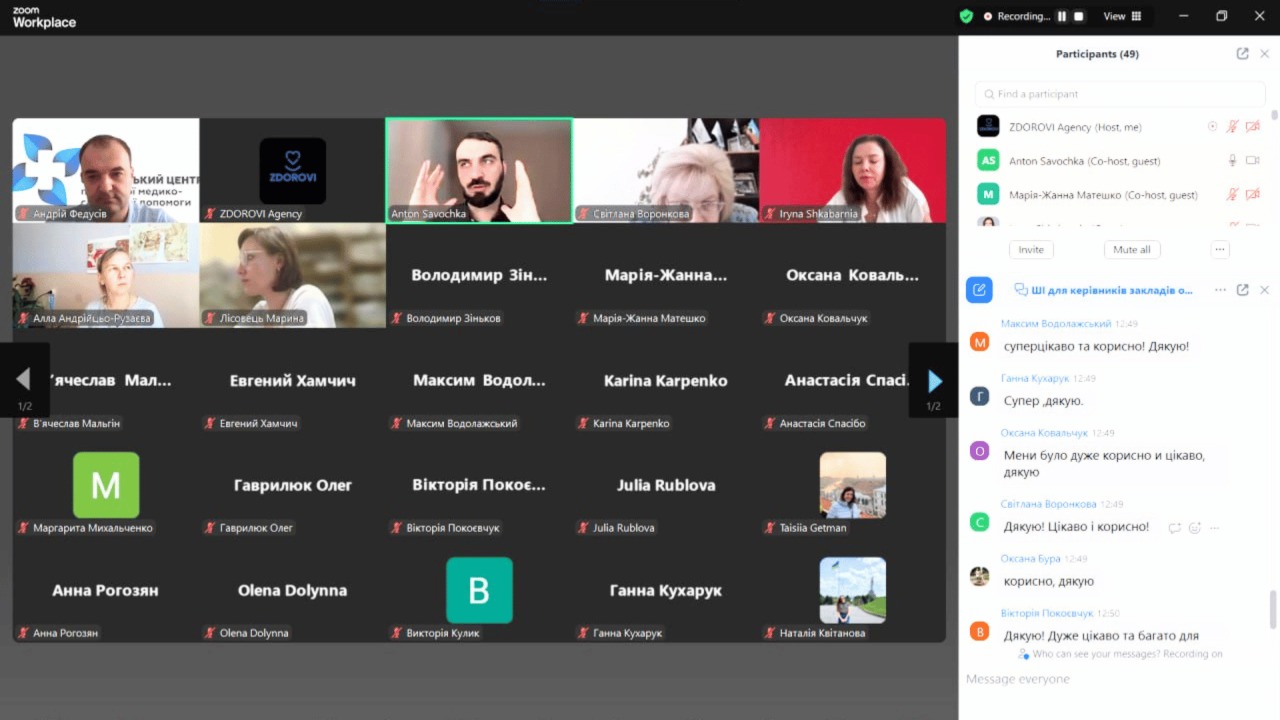
The training was organized by ZDOROVI with financial support from GlobalGiving.
© 2026 zdorovi. all rights reserved.
контакти
strategy@zdorovi.agency
+380508000924 - контакт-центр фонду
Адреса: 01014, м. Київ, вул. Звіринецька, 63, офіс 1
website by WHYER.AGENCY