Working under increased pressure due to wartime conditions, healthcare workers are increasingly facing new challenges. To help healthcare workers reduce the risk of potential conflicts and provide them with practical tools and methods for quickly and effectively resolving difficult situations, the ZDOROVI team conducted a series of conflict management training sessions for staff at healthcare facilities in the Sumy region.
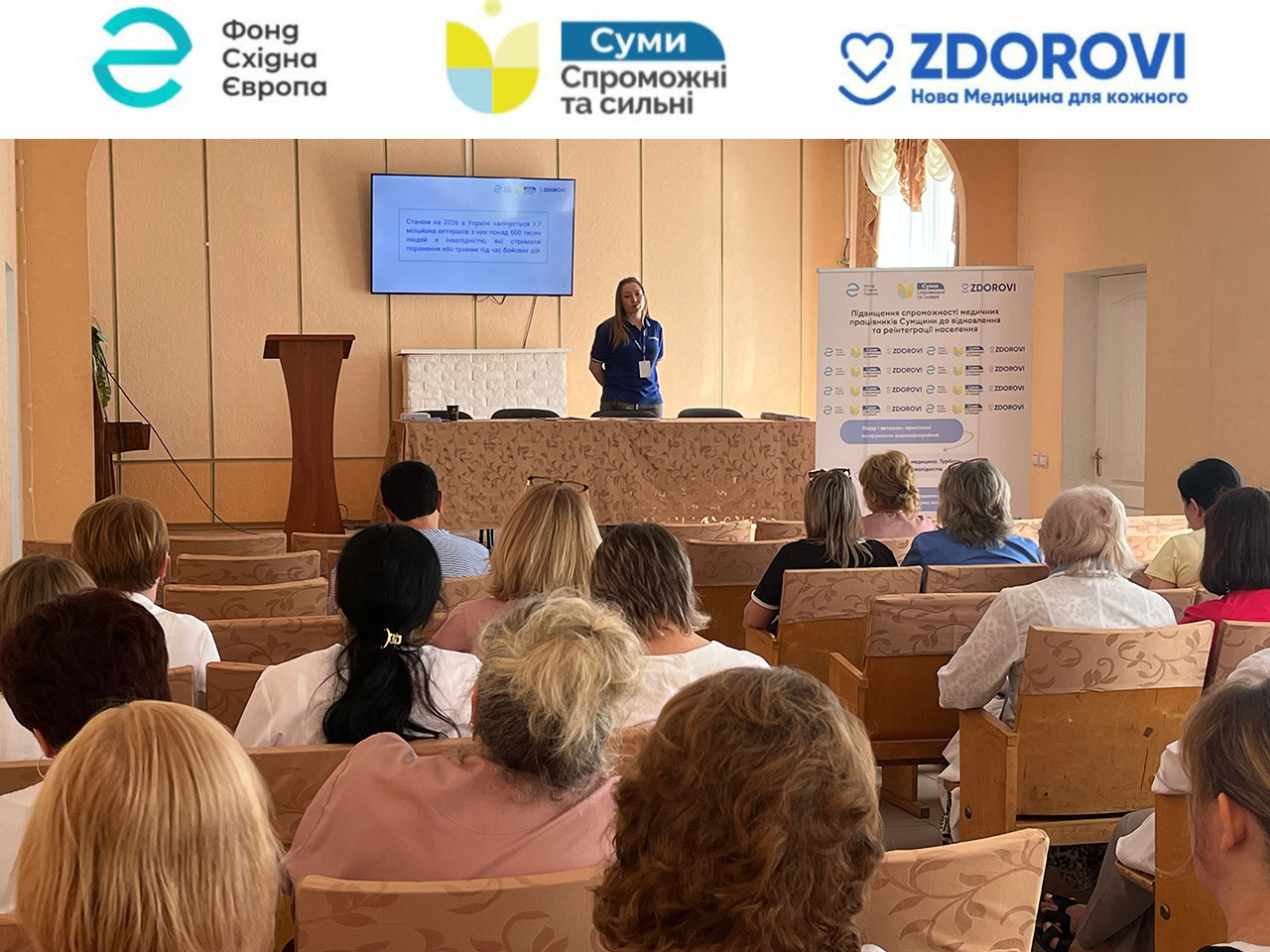
Working under increased pressure due to wartime conditions, healthcare workers are increasingly facing new challenges. A significant number of patients are experiencing emotional distress, which — combined with limited resources, complex working conditions, and a high volume of patient inquiries — creates additional risks of conflict. Even routine situations — such as long wait times for appointments, unclear explanations of treatment, or a sharp response — can lead to tension in interactions between patients and healthcare professionals.
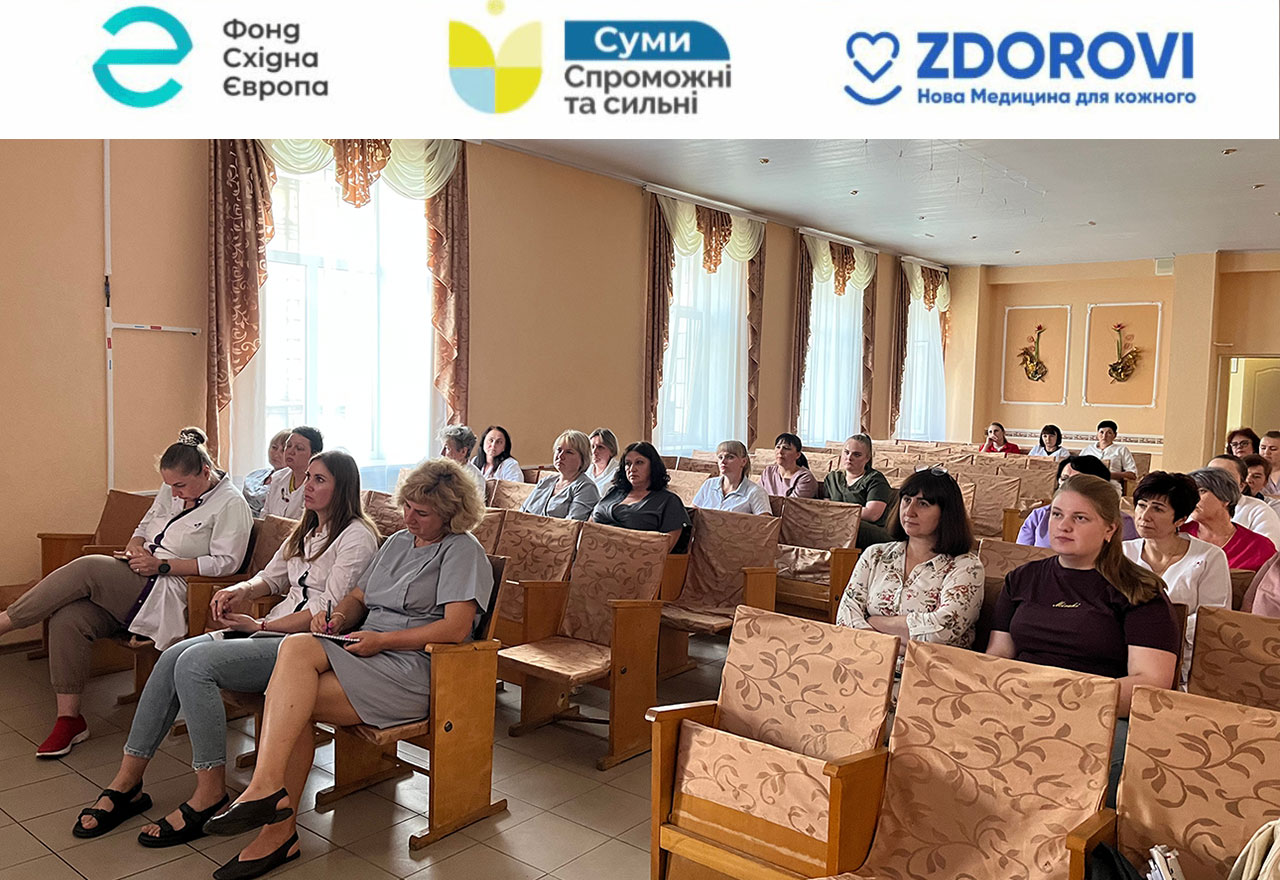
To help healthcare workers reduce the risk of potential conflicts and provide them with practical tools and methods for quickly and effectively resolving difficult situations, the ZDOROVI team conducted a series of conflict management training sessions for staff at nine healthcare facilities in the Sumy region as part of the project “Strengthening the Capacity of Healthcare Workers in the Sumy Region to Support Recovery and Reintegration of the Population.”
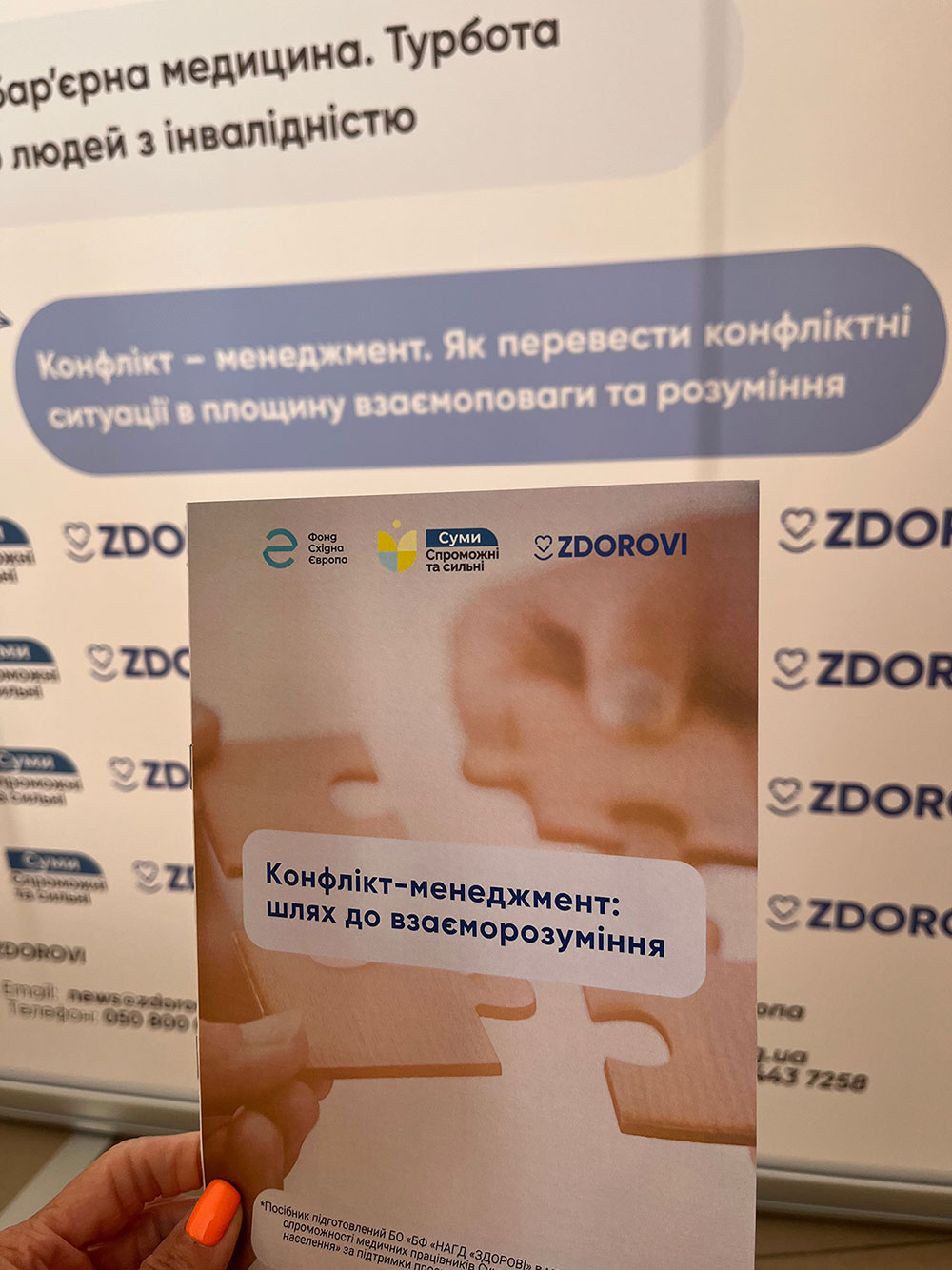
The training took place as part of the “Capable and Resistant: Sumy” program, implemented by the East Europe Foundation. In addition to the training sessions, healthcare professionals received a training manual titled “Conflict Management: The Path to Mutual Understanding,” developed by ZDOROVI experts to concisely and systematically illustrate, through concrete examples, the principles of healthy, partnership-based interaction between healthcare workers, patients, and their families.
Why Do Conflicts Arise?
Conflicts in healthcare settings often arise not only because of people’s behavior but also due to organizational shortcomings, such as delays in care, poor communication, refusal to provide care, breaches of confidentiality, or dismissing a patient’s emotional state. All of these factors can lead to escalating tension, a loss of trust, and burnout among healthcare professionals.
Under high-pressure conditions, conflicts can escalate very quickly: a patient may feel unheard, while a healthcare professional may perceive a complaint as a personal attack. That is why it is important not only to respond to conflicts once they arise but, first and foremost, to prevent them from occurring in the first place.
Conflicts often arise simply because of a lack of information. A key step is to ask yourself: “Have I explained the situation clearly enough?” If tensions are rising, it can help to change the setting — move to a quieter, calmer environment — and reaffirm your willingness to help resolve the issue.
Conflict Resolution in Medical Practice
The foundation of an effective approach is a partnership-based method, in which the healthcare provider and the patient work together to resolve the problem. This means addressing both the emotional and practical aspects of the situation. First, it is important to reduce tension by acknowledging the patient’s emotions, and then move on to specific steps to resolve the issue.
In practice, this means listening attentively to the patient, clarifying their needs, thanking them for raising the issue, and clearly explaining the next steps. It is important to avoid formal or stock phrases and instead use more personalized language that demonstrates genuine engagement and a willingness to help.
During difficult conversations, it is important to acknowledge the patient’s emotions with phrases such as, “I can see that you’re upset” or “I’m sorry you’re going through this.” At the same time, avoid phrases like “Calm down,” “Everything will be okay,” or “I understand you.” Instead, try asking: “How can I help you right now?”
Another important principle is to avoid making personal promises and instead act within the capabilities of the healthcare facility, adhering to agreed timelines and decisions. This helps build trust and reduce tension, even in difficult situations.
The practical tips for healthcare professionals outlined above, which ZDOROVI experts shared during online and in-person conflict management training sessions, can provide a valuable foundation for improving the quality of healthcare services, particularly in frontline regions, where constant stress and pressure can periodically lead to conflicts in healthcare facilities.
These practical tools for responding constructively can help reduce emotional tension between healthcare workers and patients and foster partnership-based communication among everyone involved.
“Conflict management is undoubtedly a useful and always relevant topic for healthcare facilities, because difficult interactions, complaints, and conflicts do no one any good when they are either avoided or allowed to escalate. It is important to learn how to handle them. Training participants identified and took away new tools for influencing situations and recognized the importance of analyzing flawed processes,” said Tetiana Kuzmenko, a psychologist and trainer at ZDOROVI, reflecting on her experience working with healthcare professionals.
The project “Strengthening the Capacity of Healthcare Workers in the Sumy Region to Support Recovery and Reintegration of the Population” is being implemented by the ZDOROVI Charitable Foundation as part of the “Capable and Resistant: Sumy” project, implemented by East Europe Foundation (EEF).
© 2026 zdorovi. all rights reserved.
контакти
strategy@zdorovi.agency
+380508000924 - контакт-центр фонду
Адреса: 01014, м. Київ, вул. Звіринецька, 63, офіс 1
website by WHYER.AGENCY